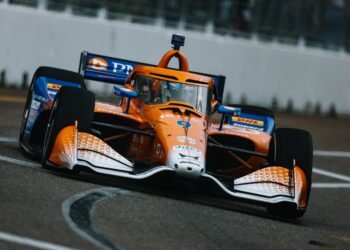


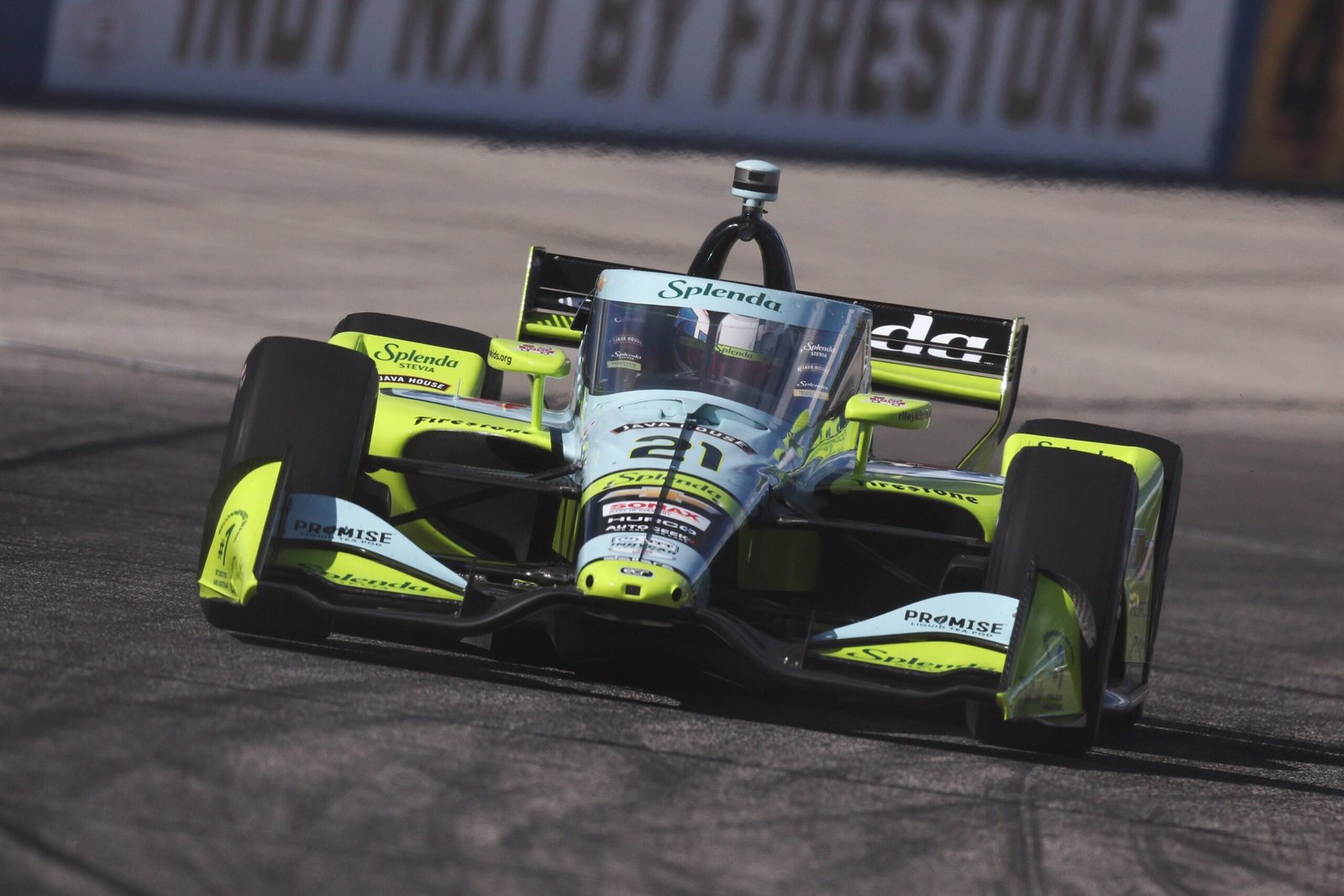
When Christian Rasmussen was asked about his ambitions for 2026, his answer was tellingly simple.

“More races like Milwaukee.”
No buzzwords. No overstatement. Just a direct reference to the weekend that changed how the paddock views him, not as a promising young driver anymore, but as a proven INDYCAR race winner.
After claiming his first victory at the Milwaukee Mile in 2025, Rasmussen enters the 2026 season with something that cannot be taught or simulated: proof. Proof that he can manage an INDYCAR race from the front. Proof that he can execute under pressure. And proof that Ed Carpenter Racing is no longer content with incremental progress.
The question now is not whether Rasmussen belongs in INDYCAR.
The question is whether 2026 can turn one breakthrough win into several.
Momentum That Feels Different
There is a noticeable shift in Rasmussen’s tone when he speaks about the upcoming season. Not louder. Not more aggressive. Just more assured.
“We definitely saw an increase in performance from ECR last year,” Rasmussen explained. “And just continuing that development, everyone within the team is very excited about what we’re bringing to 2026.”
That optimism is not blind. It is rooted in tangible change. Over the winter, Ed Carpenter Racing invested heavily in people, processes, and preparation. Engineers. Pit crew. Physical performance staff. Even a dedicated strength and pit stop coach, details that matter in a series where margins are measured in hundredths of a second.
“All the parameters are cranked,” Rasmussen said. “We’re doing everything we can to catch up to the big players.”
That sentence alone reflects how far ECR’s mindset has evolved.
Rasmussen’s INDYCAR journey has never been rushed. Unlike some rookies thrown into sink-or-swim situations, his path has been deliberate, sometimes painfully so.

His first season showed flashes, but not consistency. His second year delivered something far more valuable: confirmation that the ceiling was real.
“Ed allowing me back into the program and giving me another opportunity was very important,” Rasmussen admitted. “Not everyone gets that.”
That trust paid off in Milwaukee. The win did not come from a chaotic fuel gamble or attrition-heavy race. It came from pace, control, and discipline, exactly the traits teams look for when deciding whether a driver can be built around.
Importantly, Rasmussen does not view Milwaukee as an outlier.
“I think that was the start,” he said. “We’re just looking to do it more than once a year.”
Can Christian Rasmussen Win Again in 2026?
Based purely on Rasmussen’s own words, the answer is clear: yes. Not just once, but potentially multiple times.
“We’re trying to compete for wins more often than we have in the past,” he said. “Being more consistently in the top five, top ten, that’s the goal.”
This is not empty ambition. Rasmussen finished 2025 as one of the highest point scorers on ovals across the entire field, ranking third overall on oval tracks. That statistic alone places him in elite company.
“We must have done something right,” he said with a smile.
The key for 2026 is not discovering speed, it is accessing it more often.
For a driver with European roots, Rasmussen’s affinity for ovals stands out. But his background explains why.
“I came to the States quite early,” he noted. “I’ve been racing on ovals since 2019.”
Unlike many international drivers who treat ovals as a necessary evil, Rasmussen thrives on them. He enjoys the sustained side-by-side racing. The constant judgment calls. The thin line between commitment and consequence.
“It just kind of clicks with me,” he said.
That comfort shows in his driving style, often described as aggressive, sometimes even “on the edge.” Rasmussen does not deny it.
“It’s something you develop all the time,” he explained. “You try to judge where the limit is.”
The results speak for themselves. High points totals. Strong race finishes. And now, a win.
Where the Work Is Still Needed
Despite the progress, Rasmussen is refreshingly candid about what must improve.
“Our qualifying performance wasn’t where we wanted it to be,” he said plainly.
In INDYCAR, qualifying can define an entire weekend, especially on road and street circuits. Starting deeper in the field forces teams into recovery mode, burning strategy options early.
ECR has made qualifying a central focus of its off-season development, and Rasmussen is eager to see the results.
“If we can improve there,” he said, “everything changes.”
That improvement may be the single biggest factor in determining whether Rasmussen becomes a consistent podium threat rather than an occasional one.
One of the most transformative changes at Ed Carpenter Racing has come through the involvement of Ted Gelov and Heartland Food Group, bringing brands like Java House and Splenda into the spotlight.
“It’s given the team opportunities we haven’t had before,” Rasmussen explained.
The impact is not limited to liveries or marketing exposure. The funding has enabled expanded development programs, better staffing, and a more professionalized structure across the organization.
“This is where ECR gets the opportunity to show its real potential,” Rasmussen said.

For a driver, that kind of stability matters. It allows focus to shift away from survival and toward execution.
Winning once in INDYCAR is hard. Winning again is harder.
Rasmussen understands that there is no simple formula.
“I wish it was copy and paste,” he joked. “But it doesn’t work like that.”
What can be carried forward, however, is approach. Preparation. Communication. Decision-making under pressure.
“It’s more about how you go through a weekend,” he said. “That’s what you can bring from one win to the next.”
That mindset reflects a driver maturing quickly, one who is no longer satisfied with isolated success.
Making the Bad Days Less Bad
Perhaps the most important line Rasmussen delivered during his press conference had nothing to do with wins.
“Limiting the bad days,” he said, “that’s a big goal.”
Championships are not built on perfect weekends. They are built on damage control. On finishing ninth instead of nineteenth. On extracting points when the car is not ideal.
Rasmussen knows that consistency, not peak performance alone, is what separates contenders from the rest.
“Being more consistently up front,” he said, “that’s success.”
Now entering another season in INDYCAR, Rasmussen speaks less about raw speed and more about understanding.
“What you can get away with. What you can’t,” he said. “You learn that every race.”
That learning curve never truly ends. But Rasmussen feels he is closer than ever to where he wants to be, not just as a driver, but as a professional.
“I really like the place I’m in right now,” he said.
It is a telling statement from someone who once had to fight simply to stay in the series.
Christian Rasmussen will not enter 2026 as a championship favorite. But he will enter it as something arguably more dangerous: a driver with momentum, clarity, and belief.

The infrastructure at Ed Carpenter Racing is stronger. The team culture is evolving. And Rasmussen himself has checked the most important box of all.
He knows how to win.
Whether that translates into one victory or several will depend on execution, qualifying gains, and continued development, but nothing in Rasmussen’s own words suggests Milwaukee was a fluke.
If 2025 was about arrival, 2026 could be about establishment.
And if things break his way, Christian Rasmussen may not just win again.
He may start doing it regularly.
written by Philipp Kraus // Media Credit: Penske Entertainment