

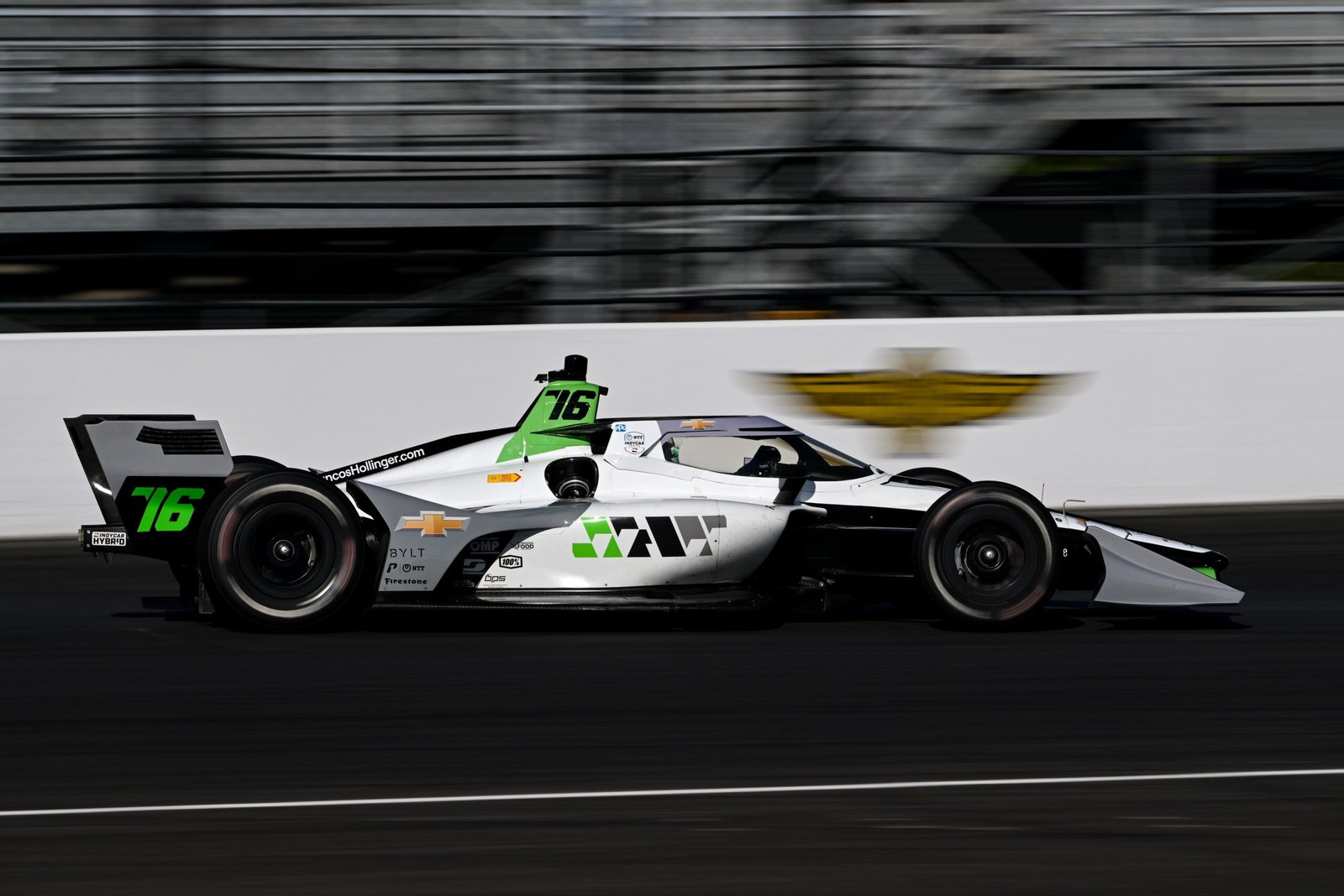
After a single, often misunderstood season with Dale Coyne Racing, VeeKay enters 2026 with Juncos Hollinger Racing, a team still carving out its place in the modern IndyCar landscape but one that increasingly signals ambition rather than survival. For VeeKay, now entering his seventh season in the series, the change represents something deeper than a new race car or power unit.

It is about ownership. Leadership. And finally unlocking a level of consistency that has hovered just out of reach for much of his career.
“I feel like it’s going to be a really good season,” VeeKay said. “Just having almost a full off-season to really work with the team, that already makes a big difference.”
Rinus VeeKay’s IndyCar résumé is deceptively strong. A race winner. A perennial points finisher between 12th and 14th. A driver trusted on ovals, increasingly respected on road and street circuits, and known throughout the paddock for his technical feedback.
And yet, the defining leap, the jump into the championship’s top tier, has remained elusive.
That reality is not lost on VeeKay himself.
“I think the big thing for championship points is top-five finishes,” he admitted. “Top 10s are good, but where you really see the difference is consistently being in the top five.”
It is a brutally honest assessment, and one that frames his move to Juncos Hollinger Racing in a new light. This is not about rebuilding a reputation. It is about sharpening it.
Why Juncos?
On paper, the move raised eyebrows. Dale Coyne Racing offered familiarity. Stability. A known quantity. Juncos Hollinger Racing offered something less tangible, but perhaps more valuable. Vision.
“It wasn’t a super easy decision,” VeeKay explained. “I really weighed both options. But when I spoke with Juncos about their off-season plans and development direction, that to me was the better decision.” That sentence reveals a key theme that runs throughout VeeKay’s 2026 outlook: development over comfort.
At one point during his Coyne tenure, VeeKay admits he may have become too comfortable, something that subtly dulled the razor edge required at this level.
“That’s not healthy,” he said. “What last year taught me is to treat every weekend like it’s your only shot.”
That mindset aligns perfectly with Juncos Hollinger Racing, a team still building, still hungry, and still searching for a driver who can unify its strengths across all disciplines.
From Road to Indy to IndyCar: A Familiar Partnership Revisited
The relationship between VeeKay and Juncos is not new. Long before IndyCar , their paths crossed in the Road to Indy ladder, back when raw pace mattered more than politics or perception.
“It’s a different ballgame now,” VeeKay acknowledged. “But having that history helps.”
The familiarity extends beyond nostalgia. It breeds trust, especially important in a team environment where VeeKay is expected not just to drive, but to lead.
“At Ed Carpenter Racing, I came in as a rookie,” he explained. “Now I’m hired as a veteran. That’s the role I’ve taken on.”
Leadership, in this context, is not about hierarchy. It is about standards. One of the most revealing moments of VeeKay’s media appearance came when he spoke about his first days inside the Juncos organization.
“No one knows how I work yet,” he said. “So however I show up on day one, that’s the standard.”
It is a telling insight into how seriously he approaches this opportunity. Juncos Hollinger Racing does not need a placeholder. It needs a reference point.

VeeKay understands that. “I want to be as professional as possible, as helpful as possible, and as much of a team player as possible,” he said.
This approach mirrors the broader evolution of his career. The 19-year-old who burst into IndyCar with fearless expectations has been replaced by a driver who understands the margins and how easily they disappear.
Consistency as a Weapon
Ask VeeKay what he brings to Juncos Hollinger Racing, and the answer is not raw speed.
“Consistency,” he said without hesitation.
He has observed the team closely over the last few seasons. With Romain Grosjean, JHR showed patience and potential on road and street circuits. With Conor Daly, it displayed progress and composure on ovals.
VeeKay believes he can connect those dots. “I think I can tie those together,” he said. “That way, we can create a front-running package for the entirety of 2026.”
That is an ambitious claim, but not an unrealistic one. IndyCar’s diversity of circuits rewards drivers who can extract results even on weekends where outright pace is lacking.
“One weekend we might win,” VeeKay admitted. “Another weekend, 12th might be the best we can do. The key is maximizing everything.”
Another subtle but important shift for 2026 is VeeKay’s return to Chevrolet power after a single season with Honda.
“It still felt like an IndyCar,” he said, smiling. “But it’s nice to be back.”
For a driver, engine manufacturers are not just about horsepower, they are about communication. Terminology. Tools. Reference points built over years.
“I don’t have to translate things in my head anymore,” VeeKay explained. “That helps more than people realize.”
The true impact, he admits, will only be felt once the car hits the track. But psychologically, the return to Chevy represents a sense of normalcy, something VeeKay values heading into a season that already carries change.
Few moments shape an IndyCar driver like the Indianapolis 500. For VeeKay, the 2025 edition was not a highlight reel, but it was formative.
“Every hard moment makes you stronger,” he reflected.

The experience of fighting through adversity, rather than cruising into the Fast Six, offered a different kind of growth. One that may prove invaluable with Juncos Hollinger Racing.
VeeKay revealed that Daly had told him the JHR car was the best he had ever driven around Indianapolis, including those from Dale Coyne Racing. That statement alone has fueled his optimism.
“I can’t wait to get on track,” VeeKay said. “Sebring is the first big day I’m really looking forward to.”
Short-Term Focus, Long-Term Ambition
Despite signing only a one-year deal, VeeKay does not view 2026 as a stopgap.
“It could be a long-term home,” he said. “We all want the same thing: we want to win.”
That alignment matters. In IndyCar, success often follows shared ambition rather than immediate resources.
For VeeKay, the contract length changes nothing about his approach.
“One-year contract or ten, it doesn’t matter,” he said. “You have to treat every weekend like it’s your only chance.”
It is a philosophy forged through experience and one that may finally push him into the championship’s top 10.
The 2026 calendar presents both challenges and opportunity. New venues. Returning classics. And a double-header at Phoenix alongside NASCAR, an oval where Juncos Hollinger Racing has quietly shown strength.
“That’s one I’m really excited about,” VeeKay said. “A good car on a short oval can make a huge difference.”
Still, he resists singling out any one race.
“I’m excited for all of them,” he insisted. “The most important thing is having a good car.”
Now entering his seventh IndyCar season, VeeKay is acutely aware of how much he has changed.
“It’s funny to look back at 19-year-old Rinus,” he said. “I had very easy expectations.”
Reality has since intervened in a good way: “I’ve become much smarter strategically in the car,” he explained. “I’m proud of the mindset I’ve built.”
That mindset, he believes, allows him to extract maximum performance. Not just from himself, but from those around him.
A Quietly Dangerous Combination
Juncos Hollinger Racing will not enter 2026 as title favorites. Neither will Rinus VeeKay. And that may be exactly what makes the pairing so intriguing.
This is not a story of instant glory. It is a story of alignment, between driver maturity and team ambition.
VeeKay does not promise miracles. He promises work. Consistency. And relentless focus.
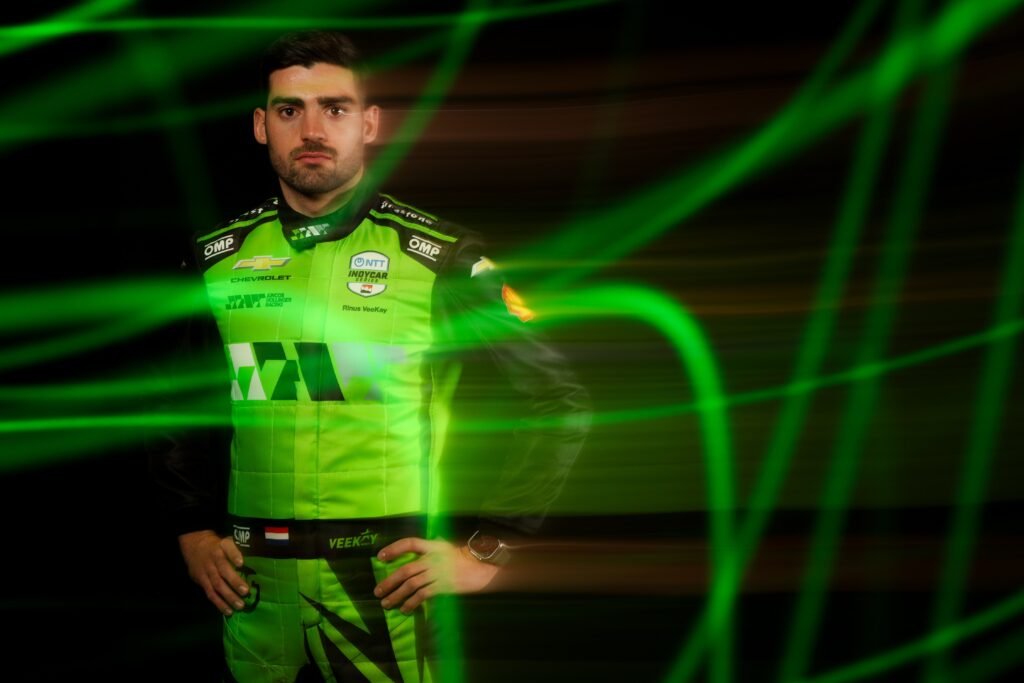
If that translates into five or six top-five finishes, as he believes it can, the IndyCar paddock may find itself re-evaluating both driver and team by season’s end.
Because sometimes, the most dangerous contenders are not the loudest ones. They are the ones playing the long game.
written by Philipp Kraus // Media Credit: Penske Entertainment