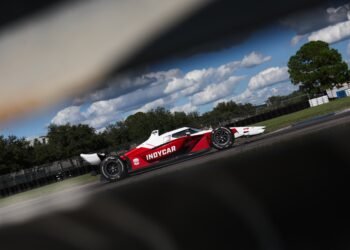


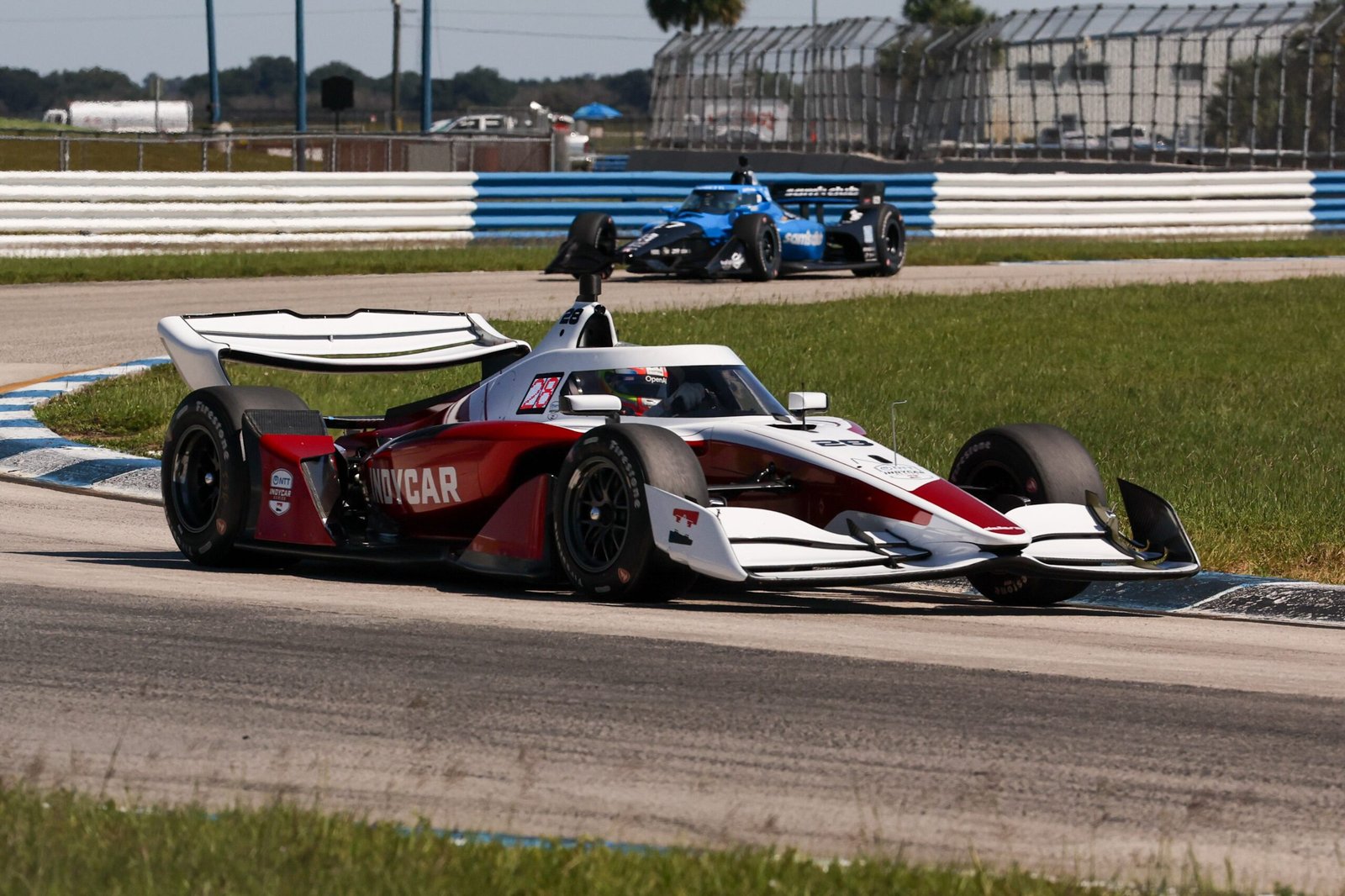
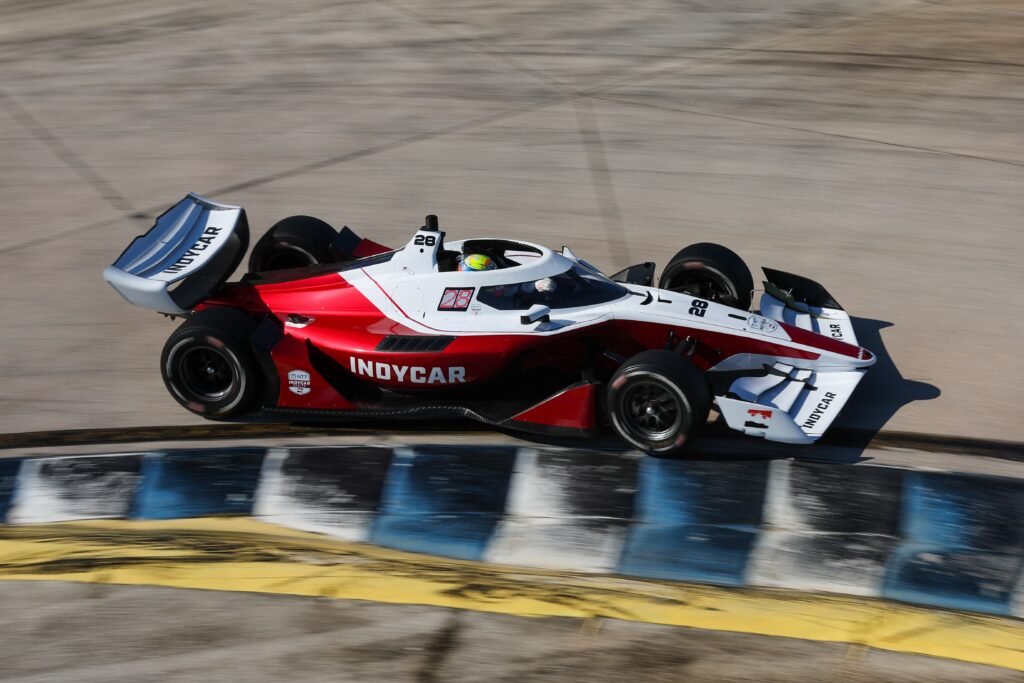
IndyCar’s next-generation IR-28 has taken another important step toward its 2028 debut. Five-time champion Alex Palou put the new chassis through its paces at Sebring International Raceway, where the rough surface offered a very different challenge from the smooth asphalt of Indianapolis. And there was even a little on-track action with Kyle Kirkwood.
The future of IndyCar is starting to take shape, and this time, things got a little rough.
After completing its first tests at Indianapolis Motor Speedway in August and September, the new IR-28 chassis headed to Sebring International Raceway on Monday, October 12, for another important development session.
Behind the wheel was none other than five-time and reigning IndyCar champion Alex Palou, who completed 43 laps around Sebring’s notoriously bumpy outer loop in the Honda-powered Chip Ganassi Racing test car.
And while the earlier runs at Indianapolis were all about getting familiar with the new machine, Sebring presented a completely different challenge.
This was about finding out how much punishment the IR-28 could take. With its mix of old concrete, asphalt and unforgiving bumps, Sebring is one of the toughest places to test a race car. That’s exactly why IndyCar chose it.
From Smooth Indianapolis Asphalt to Sebring’s Brutal Bumps
The first IR-28 tests at Indianapolis Motor Speedway gave engineers an opportunity to evaluate the new chassis on both a road course and an oval.
But Indianapolis is relatively smooth compared with many of the temporary street circuits on the IndyCar calendar. Sebring is a different animal altogether. Its notoriously uneven surface makes it a favorite testing destination for IndyCar teams, especially when they want to understand how a car will behave on bumpy street circuits.
That matters because street racing accounted for roughly one-third of the IndyCar schedule in 2026. The new chassis needs to cope with everything from high-speed oval racing to tight corners, heavy braking zones and rough city streets. Palou explained that the team was deliberately pushing the car through difficult conditions to uncover potential weaknesses before production begins.
“We’re trying to test it as tough as we can,” Palou said. “We’re trying to get miles and miles, see what breaks so we can fix it.”
That might not sound particularly glamorous, but it’s one of the most important parts of developing a new race car. The goal isn’t simply to set impressive lap times. Engineers need to understand how the suspension, chassis and other components respond to repeated stress. If something breaks now, there’s still time to improve it. If something breaks during a race in 2028, that’s a much bigger problem.
Alex Palou Already Notices Major Improvements
One of the most interesting developments from the Sebring test wasn’t related to outright performance. It was driver comfort.
Anyone who has followed IndyCar in recent years knows that cockpit temperatures have been a recurring talking point, particularly since the introduction of the aeroscreen in 2020.
The aeroscreen brought a significant safety improvement, but it also changed airflow around the cockpit. Cooling ducts were subsequently incorporated into the existing car’s bodywork to help drivers deal with the heat. With the IR-28, engineers have had the opportunity to approach cockpit cooling differently from the beginning.
Rather than adapting an existing design, the new chassis features strategically positioned cooling ducts as part of its original development. And according to Palou, the difference is already noticeable.
“Yeah, it’s been so much better, the cooling, since we started a couple months ago,” he explained. He also highlighted a large duct positioned directly in front of the driver, which helps guide air upward and improve circulation inside the cockpit.
For drivers who spend long periods racing in extreme temperatures, that’s a welcome change. Palou also reported improvements following his earlier feedback on braking and driver comfort during the Indianapolis tests. It’s a useful reminder that developing a new IndyCar isn’t just about making it faster or more visually appealing.
The car also needs to be comfortable enough for drivers to extract its full potential over an entire race distance. And if the early feedback is anything to go by, the IR-28 is moving in the right direction.
The IR-28 Makes Its First On-Track Pass: Against Kyle Kirkwood
There was also a rather entertaining moment during Monday’s session.
While Palou was busy developing IndyCar’s future chassis, Kyle Kirkwood was at Sebring testing Firestone Firehawk tires in a current-generation Andretti Global car with Scott McLaughlin of Team Penske being also part of the tire test.
That created an unusual opportunity: the new IR-28 and the current IndyCar sharing the circuit at the same time. And Palou couldn’t resist a little racing.
During the afternoon, he passed Kirkwood, marking the first on-track overtake completed by the new chassis. It wasn’t originally part of the plan.
“It wasn’t planned,” Palou admitted.
The drivers had discussed running together during their lunch break, giving Palou a chance to experience how the IR-28 behaved around another car.
What started as a development exercise turned into a little bit of fun.
“We wanted to see how this car does in traffic. It was cool. We were playing a little bit.”
It’s only a small moment in the IR-28’s development story, but an interesting one nonetheless. After all, one of the biggest questions surrounding any new IndyCar is how well it will race against other cars.
And that brings us to perhaps the most exciting part of Palou’s early feedback.
Could the New IndyCar IR-28 Deliver Better Racing?
A new chassis is always an opportunity to address weaknesses in the previous generation. For IndyCar, one of the most important areas is how closely drivers can follow one another. The ability to stay close through corners can make a huge difference when it comes to overtaking opportunities, particularly on road and street circuits.
Palou is optimistic about what the IR-28 could deliver.
“It looks like it’s going to be much better racing because we’re going to be able to follow much closer on road, street and ovals,” he said. That’s an encouraging early assessment.
Of course, testing one car alongside another isn’t the same as racing a full field on a busy street circuit. There’s still plenty of development work ahead before anyone can confidently say how the new chassis will change the racing. But Palou’s comments suggest that the drivers are already looking forward to what the new generation could offer. If the IR-28 allows cars to follow more closely without losing as much performance, it could help create more opportunities for wheel-to-wheel battles.
And that would be good news for IndyCar fans.
Why Sebring Is Such an Important Test for the IR-28
Sebring offers another major advantage beyond its challenging surface. Data. IndyCar teams have spent years testing their current cars at the Florida circuit, giving engineers a substantial amount of information to work with. That makes it easier to compare the behavior of the IR-28 with the existing chassis.
Engineers can examine how the new car responds to bumps, braking loads and changing track conditions while drawing on their knowledge of the current machine. For a chassis that will eventually need to perform on ovals, permanent road courses and temporary street circuits, that comparison is extremely valuable.
The development program also involves Dallara and IndyCar officials, who are working through an extensive checklist of mechanical systems, performance characteristics and reliability requirements.
At this stage, the priority is understanding the car and identifying areas that need further work.
And Sebring is an ideal place to expose those areas.
A car that survives the punishment of this circuit is taking a useful step toward the demands of a full IndyCar season.
The Countdown to IndyCar’s 2028 Future Continues
It’s easy to get excited whenever a new race car appears on track.
The IR-28 represents a significant step for IndyCar, and its development will be one of the biggest technical stories to follow over the next couple of seasons.
But the series isn’t rushing things. The new chassis is scheduled to make its competitive debut at the beginning of the 2028 season, giving engineers time to complete additional testing and address any issues that emerge.
Palou, unsurprisingly, would love to get racing sooner.
“I’m just excited to go racing,” he said. At the same time, he understands why the development timeline matters. More testing means more opportunities to improve reliability, refine the driving experience and ensure the chassis performs properly on different circuits.
That includes ovals, where stability, aerodynamic behavior and safety are especially important.
And while the IR-28 has already completed tests at Indianapolis and Sebring, there’s still plenty to learn before a full grid of cars lines up for its first race.
Early Signs Are Encouraging, but the Real Work Is Just Beginning
So, what can we take away from the latest IndyCar IR-28 test?
First, the development program is progressing beyond the controlled environment of Indianapolis. Sebring has introduced the new chassis to a much rougher and more demanding surface, allowing engineers to gather information that simply wouldn’t be available on smoother circuits.
Second, the early improvements to cockpit cooling appear to be working. That’s particularly encouraging given how much attention driver comfort has received in recent seasons.
Third, Palou seems genuinely excited about the car’s potential, particularly when it comes to following other drivers more closely.
And finally, we have already seen the first little taste of the IR-28 running in traffic, courtesy of Palou and Kirkwood. It wasn’t a proper race, of course. But seeing the next-generation IndyCar sharing the track with the current machine offers a glimpse of what lies ahead.
There will be more tests, more engineering changes and almost certainly a few unexpected challenges before the IR-28 reaches the starting grid in 2028.
For now, though, the early signs are positive. The new car has survived its first taste of Sebring’s bumps, its cooling system is showing promising improvements, and the drivers involved in its development are looking forward to racing it.
The IR-28 still has a long road ahead. But IndyCar’s next chapter is beginning to feel a little closer.

written by Philipp Kraus // Media Credit: Penske Entertainment