

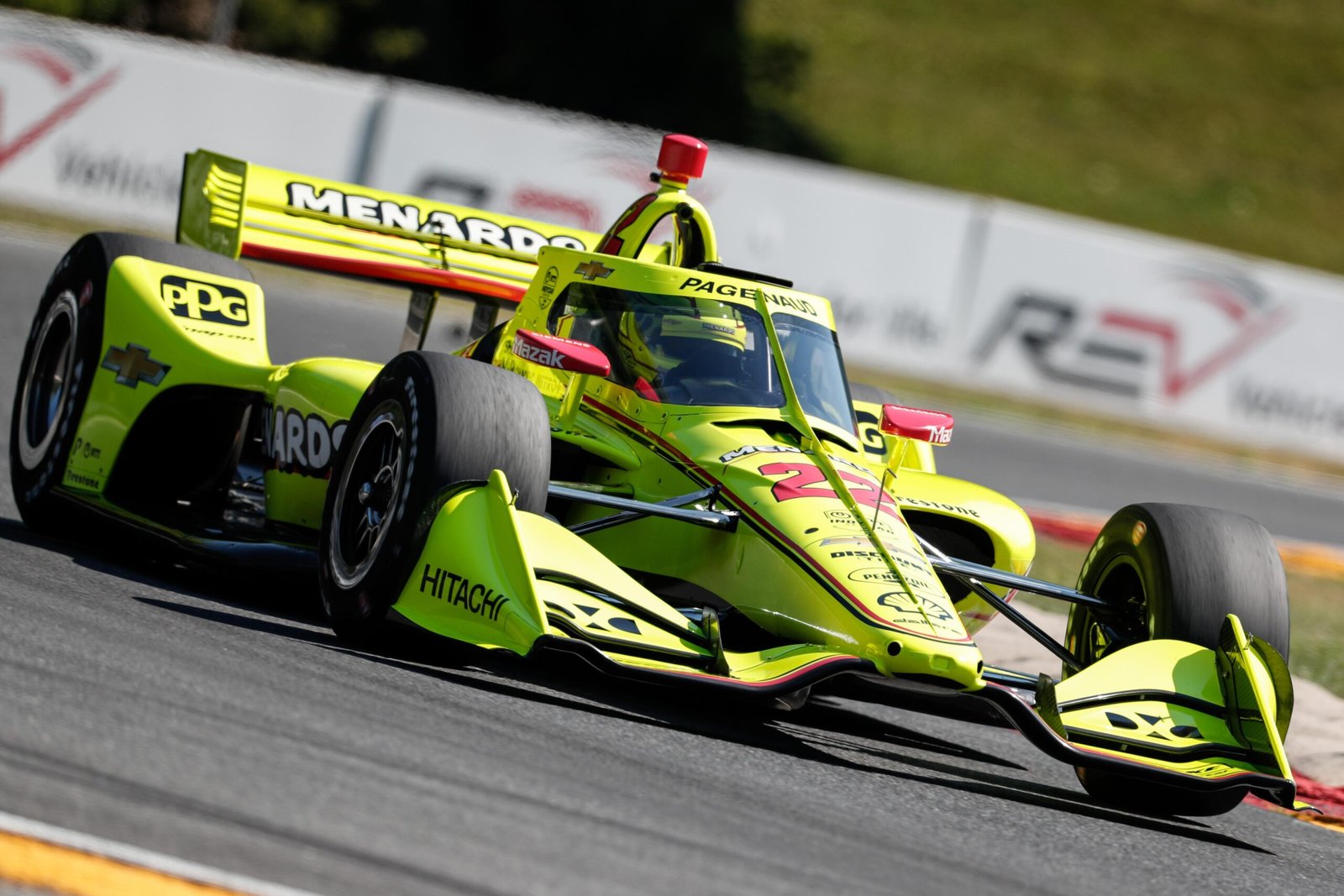
There are racers who win races and then there are racers who define eras. Simon Pagenaud may not be the most talked-about name in the global motorsport spotlight, but in IndyCar circles, he represents a unique blend of technical brilliance, calm consistency, and calculated aggression. With a career that took him from the tight circuits of Europe to the roaring ovals of the United States, Pagenaud became one of the most respected drivers in the IndyCar paddock. And in 2016, he reached the pinnacle of American open-wheel racing with a championship season that was nothing short of surgical in execution.

From France to the Fast Lane: Pagenaud’s Climb to IndyCar
Born in Montmorillon, France, in 1984, Simon Pagenaud started his racing journey like many of his peers, in karting. His early career saw him working through the traditional European ladder, climbing into Formula Renault and Formula 3. However, it was in the United States that Pagenaud would truly find his path. Like several other international drivers, he saw opportunity in the American racing landscape, particularly in sports cars and open-wheel series like Champ Car.
Pagenaud’s first major breakthrough came in 2006 when he won the Champ Car Atlantic championship, beating future F1 driver Graham Rahal in the process. That title earned him a seat in the Champ Car World Series the following year, racing for Walker Racing. Though the team wasn’t among the front-runners, Pagenaud proved his talent with several solid performances.
When the open-wheel unification between Champ Car and the IRL took place in 2008, Pagenaud found himself temporarily without a ride in IndyCar. Undeterred, he transitioned to sports car racing and made a name for himself in the American Le Mans Series (ALMS). Between 2010 and 2011, driving for the powerhouse team Highcroft Racing and later for Peugeot in endurance racing, Pagenaud scored major wins and finished runner-up in the ALMS championship.
These performances reignited his open-wheel ambitions, and in 2011, Pagenaud was given a chance to substitute in several IndyCar races. He impressed immediately, enough to earn a full-time ride with Schmidt Hamilton Motorsports (now Arrow McLaren) for the 2012 season.
Establishing Himself in IndyCar
Pagenaud’s first full season in IndyCar showcased exactly what kind of driver he was: consistent, thoughtful, and always in contention. He earned the Rookie of the Year title for the series, finishing a strong fifth in the championship with four podiums.
From 2012 to 2014, Pagenaud continued to grow. He claimed his first IndyCar victory in 2013 at the Grand Prix of Detroit and followed that up with more wins in 2014, finishing fifth and third in the championship respectively. But it was clear that he needed a team with more resources and a sharper edge to fight at the very top.

That opportunity came in 2015 when Pagenaud joined Team Penske, the most storied and successful team in IndyCar history. Penske’s legendary engineering depth and structured team environment suited Pagenaud’s personality perfectly. Though his first year was a learning curve, finishing 11th in the standings, the foundation was laid for something truly special in 2016.
The 2016 IndyCar Championship Season: A Masterclass in Control
Simon Pagenaud’s 2016 season is remembered as one of the most strategically brilliant campaigns in modern IndyCar history. Armed with the No. 22 Team Penske Chevrolet, Pagenaud clicked with his engineering team, led by Ben Bretzman, to deliver consistent performances on all types of circuits — street, road, and oval.
After a modest start at St. Petersburg with a 13th-place finish, Pagenaud kicked off a streak that would define his championship run. He scored three consecutive wins at Long Beach, Barber Motorsports Park, and the Grand Prix of Indianapolis, a trifecta of road and street courses that showcased his technical skill and smooth driving style.
The key to Pagenaud’s success was not only speed, but intelligence. While other drivers pushed the limits and sometimes paid the price with crashes or penalties, Pagenaud was calm and calculating. He understood tire degradation, fuel mileage, and track position better than almost anyone on the grid.
His fourth win of the season came at Mid-Ohio, another technical road course where he dominated despite pressure from teammate and closest championship rival Will Power. By the time the series arrived at the final round in Sonoma, Pagenaud had five wins and was leading the championship standings.
In one of the most pressure-filled weekends of his life, Pagenaud delivered yet again, winning the race and sealing his one and only IndyCar title. His victory was poetic. He didn’t just coast to a title, he won the finale and the crown on the same day, showing that he could close the deal when it mattered most.
What Made Pagenaud a Deserving Champion
While talent is a baseline in IndyCar, champions are made through consistency, mental strength, and adaptability. Pagenaud’s 2016 season was a showcase of all three.
He won five races that year, the most of anyone, and finished on the podium eight times. His average finish across the season was an outstanding 6.4. But perhaps most importantly, Pagenaud rarely made mistakes. His smooth and methodical driving style preserved the car while also extracting maximum performance when needed.

Pagenaud also thrived under the intense pressure of racing for Team Penske. The expectations were sky-high, and the competition was brutal, with teammates like Will Power and Helio Castroneves breathing down his neck every weekend. Yet Pagenaud remained composed and focused, delivering results with relentless precision.
Another vital element was his partnership with race engineer Ben Bretzman. The duo had worked together for years and shared a level of trust and communication that few other pairings could match. Bretzman’s ability to make the right calls and Pagenaud’s flawless execution proved to be the winning formula.
Beyond the Championship: Pagenaud’s Legacy
Though 2016 was the pinnacle, Pagenaud continued to deliver strong performances in the following years. He won the Grand Prix of Indianapolis again in 2019 and delivered one of the most memorable drives of his career by winning the 2019 Indianapolis 500, leading 116 of the 200 laps.
With that victory, he became one of the rare drivers to win both the IndyCar Series title and the Indianapolis 500, solidifying his place in American motorsport history. For a French driver to achieve that on the biggest stage in the US was nothing short of remarkable. He was the first French winner of the Indy 500 since Gaston Chevrolet in 1920, breaking a century-long drought.
In his later years with Team Penske and then with Meyer Shank Racing, Pagenaud took on more of a mentorship role while still delivering competitive results. His career was abruptly paused due to a heavy crash in 2023 during practice, which led to lingering health issues and eventually saw him stepping away from full-time competition.

What’s Next for Pagenaud?
Though no longer racing full-time, Simon Pagenaud remains an influential voice in motorsport. With his deep technical knowledge, calm demeanor, and wealth of experience, he is often mentioned as a potential future team advisor, coach, or even broadcaster.
His legacy is not defined by the number of races he won, but by how he won them. In a sport filled with adrenaline, aggression, and high-speed chaos, Pagenaud brought discipline, focus, and an almost surgical precision that made him a champion.
Whether it was threading the needle through tight corners or managing fuel strategy on the fly, Simon Pagenaud’s style was always thoughtful and composed. His 2016 title remains one of the most complete and deserved championship runs of the modern IndyCar era.
As fans look back at the last decade of the NTT IndyCar Series, one name will always stand out for its class, consistency, and quiet dominance: Simon Pagenaud.
written by Philipp Kraus / Media Credit: Penske Entertainment