
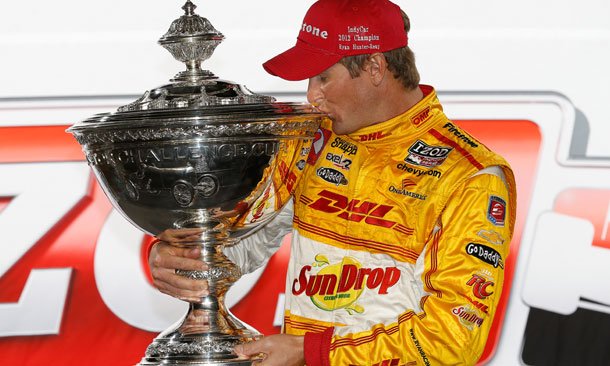
ADVENT CALENDAR DOOR 13 // 13 Years Later: Ryan Hunter-Reay Becoming IndyCar Champion
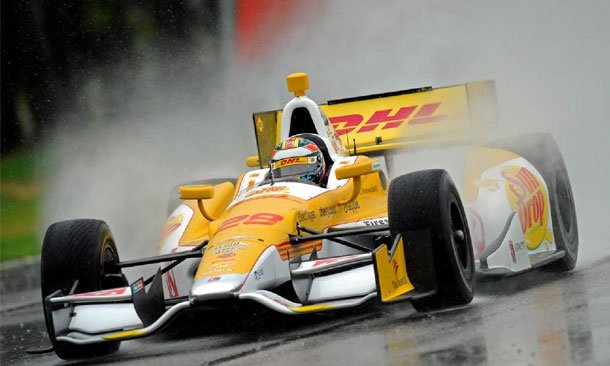
Even after more than a decade the 2012 season remains a turning point for American open‑wheel racing and a defining moment in the career of Ryan Hunter‑Reay.
“13 years later” may sound like a long time but when you look back through the list of rule changes, pivotal races, and dramatic finales it is clear why the year stands out.
For Hunter‑Reay the title was far more than luck, it was consistency, adaptability and a timing that few could match.
New Cars, New Engines and a Resurgent Series
2012 was always going to be memorable because it was the first year under IndyCar’s then-new regulations, which introduced the new Dallara DW12 chassis and turbocharged V6 engines.
The sport had been through turbulent times after the tragic death of Dan Wheldon at Las Vegas in 2011 and the new rules were designed both to improve safety and to refresh the on‑track product.
Changes had a real impact: drivers had to adjust to new aero behaviour, new power delivery and a broader variety of venues including more road and street courses. In many eyes the 2012 season was a reset for IndyCar, a fresh start.
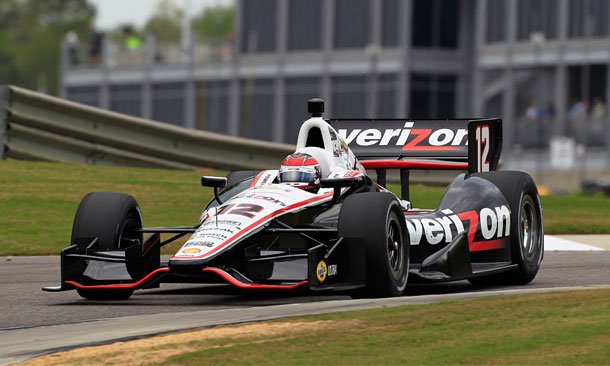
That fresh start opened opportunity. Established teams like Penske secured the Chevrolet works engine and put cars up front early, while Honda and other manufacturers sought to hang on.
The variety of tracks, from St. Petersburg’s tight street layout to the huge speeds of Texas and the oval slug‑fest of Fontana, meant the driver who could handle it all would finish on top. What unfolded was a true championship battle, one of the closest in modern IndyCar history.
Key Races and Turning Points
The season opener in St. Petersburg set the tone: speed and poles were going to matter more than ever, and Will Power immediately looked like the man to beat.
But by mid‑season several signs pointed to Hunter‑Reay. One of the most important early moments came at Toronto: Hunter‑Reay took his third straight win there, moved into the points lead and showed he could deliver when the spotlight was on him.
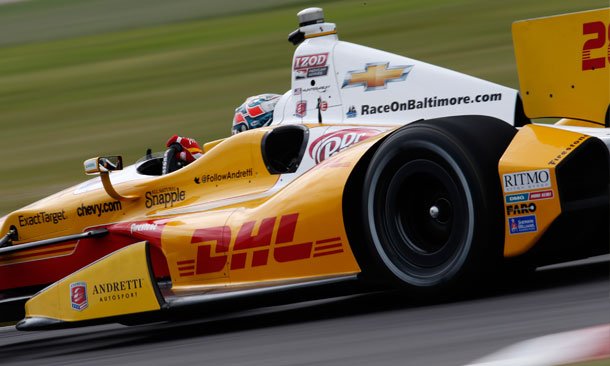
Another moment that defined his year was Baltimore. The street race in Baltimore may not be the most historic circuit but the conditions and strategy played into Hunter‑Reay’s hands.
He delivered what many called the “drive of the year”, navigating a tricky wet circuit, choosing slick tires when others did not, and seizing the moment. That win at Baltimore pulled him closer to Power in the championship and signalled that he was not just consistent, he was dangerous.
Then came the finale at Fontana. Heading into the race Power held a 17‑point lead over Hunter‑Reay. On lap 55 Power crashed, leaving Hunter‑Reay needing a fourth‑place finish to clinch the title and he achieved exactly that.
By three points he claimed the championship. The finale may have turned on a single incident, but the truth is Hunter‑Reay had earned every point through the season. Many drivers crashed, lost focus or fell back, but he stayed there, week in, week out.
It is worth noting other battles: Scott Dixon and Dario Franchitti both fought in 2012, and Penske’s dominance in qualifying reminded everyone that the levels were high.
But in the end the driver who could bring speed, adaptability and mental strength across the full calendar triumphed.
Why Ryan Hunter‑Reay Was a Deserving Champion
The story of Hunter‑Reay’s 2012 title is not one of just opportunism, it is a testament to his evolution as a driver. He mastered all types of tracks: road, street and oval.
Not every driver excels at ovals, but Hunter‑Reay did well enough to keep the pressure on late in the year. He avoided major mistakes, kept his finishes strong and made fewer swings than many of his rivals.
In an era of technical upheaval his car control and adaptability stood out. The new chassis and engines brought unknowns, not just for rookies but for teams who had to contend with fresh aero behaviour.
Drivers who thrived did so by staying within the margins and extracting maximum from each session. Hunter‑Reay did exactly that.
Moreover his late‑season surge, winning at Toronto, dominating in Baltimore and staying consistent through Mid‑Ohio and Sonoma, gave him the momentum.
Some drivers hit peaks early and faded; others had talent but lacked consistency. Hunter‑Reay blended both.
The fact that he beat Power, one of the fastest drivers of that era, and held off Dixon, a model of consistency, reinforces that his win was not a fluke. The margin (just three points) is close, but the broader metrics matter: wins, podiums, penalties avoided, points scored. Hunter‑Reay excelled in the full package.
Finally the human factor: rarely do you see a driver rise quietly, build momentum and finish on top without dominating headline after headline. Hunter‑Reay showed patience, maturity and perhaps above all a desire to make the most of his chance. In that sense he delivered a blueprint for how a contemporary IndyCar champion could emerge.
The Legacy of 2012
Thirteen years later the ripples from 2012 still influence the series. The DW12 chassis set the technical foundation for multiple years.
The competitive model, where drivers must excel across ovals, street circuits and road courses, is effectively the template still used today. For fans of the sport the season remains a highlight.
Ryan Hunter‑Reay’s triumph remains meaningful: he became a champion at a time of change, proved his versatility and helped reinvigorate American open‑wheel racing in a moment when the series needed heroes.
For younger drivers his story is inspiration: consistency matters, adaptability matters, and timing matters.
Looking back now you can say: that season was the moment when IndyCar showed it could evolve and remain relevant. It had urgency, stories, emotional arcs and a worthy champion.
Hunter‑Reay’s title is part of that story.
Each year when the calendar flips to March and the season begins we remember that in 2012 one driver navigated the biggest shift in the sport, beat the best, and came out on top.
And for that reason his name remains etched in the history of the sport, to the fans, to the teams and to those who knew the weight of the moment.
written by Philipp Kraus / Media Credit: Penske Entertainment