

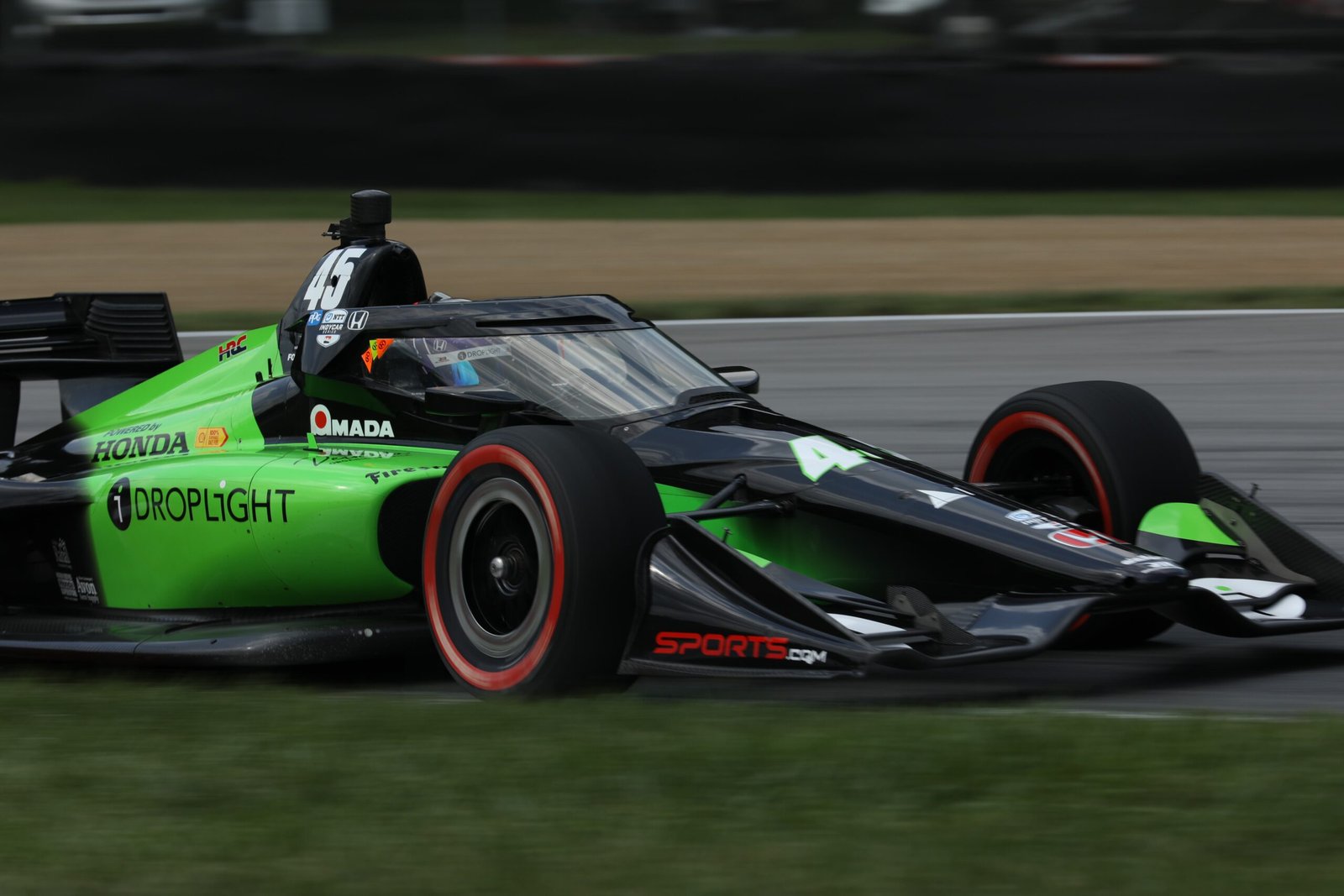
A few days ago, Rahal Letterman Lanigan Racing (RLL) and Droplight announced a long‑term, multi‑year extension of their strategic partnership, with Droplight continuing as primary sponsor of RLL’s No. 45 entry. At first glance, it might seem like just another driver‑team‑sponsor announcement. But when one digs deeper, the deal holds broader implications, especially for the health, growth, and credibility of the IndyCar paddock.

Here are several reasons why this kind of commitment is a positive for IndyCar:
A Non‑Cryptocurrency Sponsor is a Positive Signal
In modern motorsport, especially in open‑wheel series, the volatility of sponsorship is one of the largest structural issues. Teams frequently operate season‑to‑season, with drivers or cars cut at the last minute because of funding problems. A multi‑year deal such as this signals stability, for the team, for the driver, and for the series. Droplight’s extension brings certainty. It means that RLL can plan further ahead: invest in car development, personnel, and marketing without the constant worry of immediate funding renewal. That in turn gives the driver (in this case, Louis Foster) the chance to focus on performance rather than fundraising. The series benefits too: one of its established teams is financially committed for the medium term. Stability fosters better competition, better planning, and a healthier series ecosystem.
In recent years some racing series, including IndyCar, have seen sponsorship from speculative or short‑term funding sources (such as certain cryptocurrency brands). While the influx of capital is welcome, the risk is that such partnerships may vanish or falter when market sentiment changes.
In this case, Droplight is not merely a token sponsor; it is described as a “venture studio” with a broader ecosystem of consumer and media brands (such as Desnuda Tequila and ICHOR Hydrogen Water) that leveraged the No. 45 car as a global platform.
That kind of diversified sponsor, one not solely based on speculative finance or limited‑time hype, is a positive for IndyCar’s brand image. It says: “We’re attracting partnering companies with serious business models, not just short‑term hype.” For the series, that enhances credibility among mainstream commercial partners, media, and fans alike.
Driver Development, Team Investment & Long Game
When a team knows it has multi‑year backing, it can allocate resources differently. You may see expanded engineering time, more driver coaching, improved facilities, and longer‑term strategic thinking. For RLL, this means that the No. 45 car might receive more consistent development rather than a “what can we do this year?” mindset.

Droplight’s commitment also benefits driver Foster, whose journey includes Rookie of the Year status and a step into full‑season IndyCar competition. Knowing the car has backing removes distractions and raises the ceiling of what he can achieve. For the series, this helps nurture talent, and strengthens the link between development series (such as INDY NXT) and the top level of IndyCar.
According to the announcement, Droplight brings “brand strategy, media expertise and innovation‑driven approach” to its partnership. In practical terms this means more than logos on a car, it means content creation, live media activations, digital storytelling, and cross‑platform engagement. For a series like IndyCar, which competes in a crowded motorsport landscape (including NASCAR, Formula 1, etc.), strong media partnerships are vital. When an entrant delivers novel marketing activations, it raises the profile of the show. More eyeballs lead to higher broadcast value, greater sponsor interest across the grid, and more mainstream coverage. If the No. 45 program under RLL with Droplight produces creative fan content, behind‑the‑scenes stories, and premium activations, it contributes to a virtuous cycle: better exposure → more sponsorship → better team performance → healthier series.
Supports the Series’ Long‑Term Commercial Stability
From a macro perspective, the strength of any motorsport series depends on a stable commercial base, with teams, sponsors, manufacturers and broadcasters aligned. Multi‑year deals help reduce churn and unknowns. For example: if teams change sponsors every year, broadcast partners may shy away due to risk; fans might struggle to follow shifting identities; growth initiatives may stall. The RLL–Droplight deal adds to IndyCar’s scoreboard of “serious partnerships,” helping the series present itself as commercially viable and maturing. It sends a message to other sponsors: investing in IndyCar can be a credible, multi‑year commitment, not just a one-off stunt. That, in turn, may encourage further long‑term sponsorships, more stable team funding, and a stronger foundation for growth.

While sponsorship may sound like a business detail, it directly influences on‑track competition. Better funding allows teams to retain engineering talent, invest in simulation and testing, and focus on performance rather than survival. Over time, that elevates the competitive standard across the grid. For IndyCar, where parity is already a strength and budget disparities are tighter than some other series, a team like RLL being stable means they can strengthen their program, challenge regularly, and raise the bar. That benefits the series by raising overall quality, encouraging other teams to improve, and enhancing the spectacle for fans.
Droplight’s model includes multiple brands and media assets; their willingness to invest long‑term in IndyCar suggests confidence in the platform’s global reach. IndyCar increasingly seeks to grow internationally; builders of brands from outside the U.S. see value in the IndyCar platform. When global or aligned brands invest in IndyCar, it helps expand the series’ footprint. More international branding means more global media coverage, potential new regional sponsorships, and a stronger global profile. In the long run, this accelerates IndyCar’s transformation from a primarily domestic series into a truly global open‑wheel championship.
Precedent for Other Teams & Sponsors
The significance of this deal is not just for RLL and Droplight, it sets a precedent. Other teams can point to this collaboration as a model: long‑term partnership with a diversified brand, media activations, and value creation beyond just “car sponsorship.” That raises expectations in the paddock and may encourage other teams to approach sponsors with more strategic, multi‑year value propositions. Sponsors may begin to see IndyCar as a longer‑term marketing channel rather than a one‑and‑done gamble. Teams may begin to secure multi‑year deals earlier, stabilizing the grid. For the series, that is a structural improvement.
Of course, any partnership has risk. But by committing multi‑year, both parties show confidence. For IndyCar, the fact that this deal was announced publicly means that the risk of immediate fallout is lower. For the driver program, it means improved planning. For fans and stakeholders, it adds credibility. Meanwhile, growth potential is enhanced: as the market stabilises, sponsors may step in earlier, teams may grow their budgets sustainably, and incremental improvements can accumulate. Instead of being locked in yearly cycles, the series may see multi‑year development across teams, a trend often seen in peak championships like Formula 1 or NASCAR.

As 2026 approaches, the IndyCar landscape is in a period of transition: new rules, evolving manufacturer relationships, growth strategies for global exposure. In such times, one firm, multi‑year deal stands out as a positive anchor. It says that even amid change, there are voices of certainty. Droplight and RLL doing this together means that at least one car, one program, is committed beyond the year‑to‑year scramble. It helps anchor the series as it grows and evolves, giving something stable for sponsors, teams, media, and fans to rely on.
Final Thoughts
The announcement of the multi‑year partnership between Droplight and RLL may not capture global headlines like a championship fight or a big driver swap, but it could be one of the more important developments for IndyCar’s commercial future. Stability, credible sponsorship, media‑savvy branding, and long‑term investment all flow from such a deal, and those are foundational if a series wants to build upward, not just maintain status quo.
For IndyCar, this kind of partnership represents a step toward maturity: the ability to attract diversified brands, retain teams financially, deliver global exposure, and raise the performance bar on track. It is a win for RLL, a win for Foster, and a win for the series.
In the end, a sport is only as strong as its ecosystem, and multi‑year deals like this help build a healthier ecosystem. If IndyCar continues to attract partnerships like this one, it will strengthen its commercial base, deepen its competitive structure, and secure its future as a premier global open‑wheel series.
written by Philipp Kraus / Media Credt: Penske Entertainment