

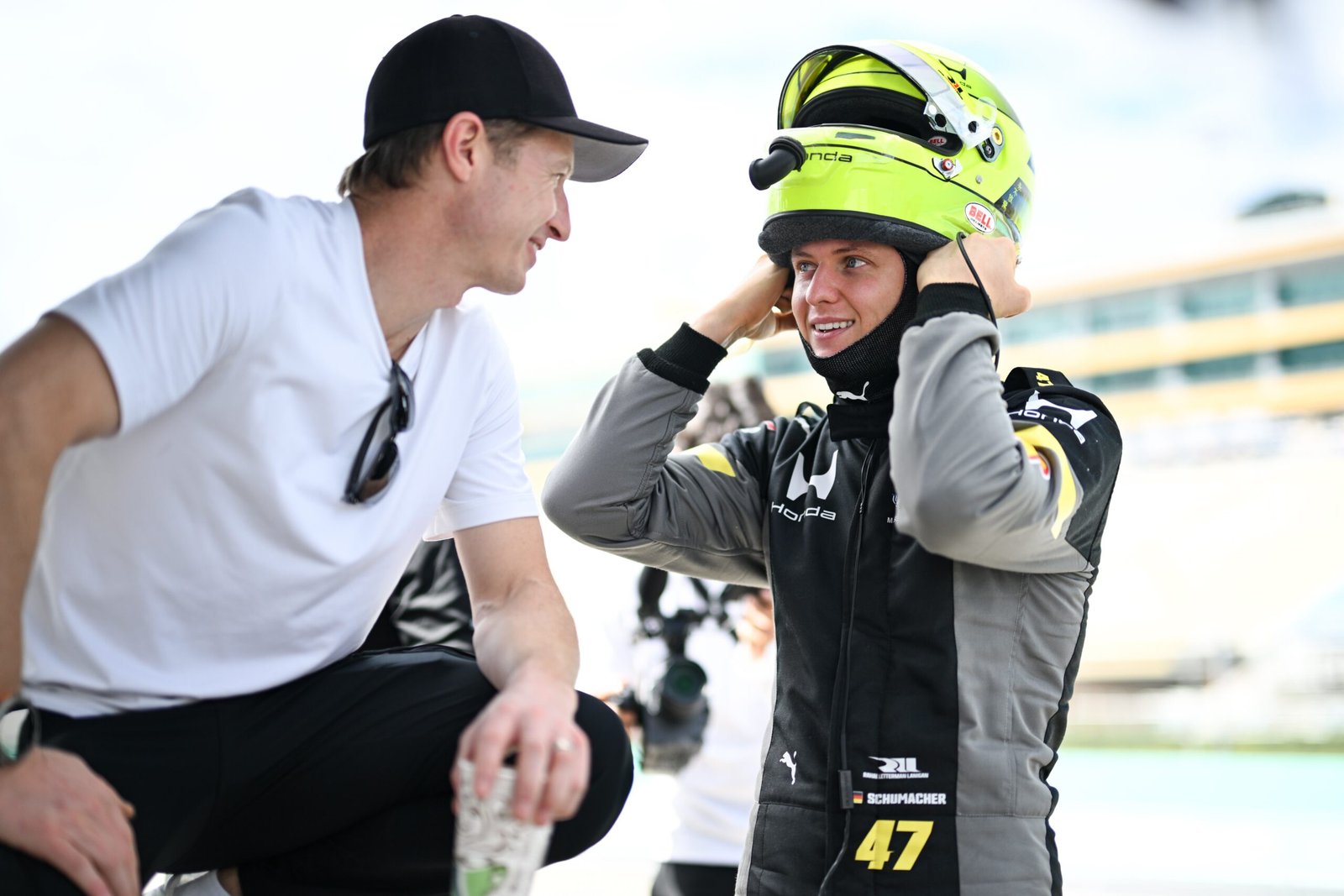
When Mick Schumacher took his seat a few days ago at the Media Day, the atmosphere around him felt different from what has followed him for much of his professional career.

There was no urgency to prove a point.
No defensiveness.
No need to reference the past.
Instead, Schumacher spoke calmly, deliberately, and with a level of self-awareness that reflected not a rookie chasing headlines, but a driver intent on building something sustainable. INDYCAR, he made clear, is not a detour, it is a conscious next chapter.
“I’m very excited about racing,” Schumacher said simply. “That’s what we’re here for.”
That sentence, understated as it may sound, framed everything that followed.
A Different Kind of Beginning
Schumacher’s move to the Rahal Letterman Lanigan Racing for 2026 places him in unfamiliar territory, geographically, culturally, and competitively. Yet it is precisely that unfamiliarity that appears to motivate him.
Unlike his entry into Formula 1, where expectation and legacy often dominated the conversation, Schumacher’s arrival in IndyCar is defined by curiosity rather than pressure.
“I feel like I’m in a much more grown-up place,” he explained. “The excitement is still there, but it’s different. It’s more structured.”
That maturity is a recurring theme throughout his comments. IndyCar, in Schumacher’s view, is not something to conquer immediately, but something to understand, piece by piece.
One of the most revealing insights from Schumacher’s interview came when he described the adjustment process itself. Not the physical demands. Not the competition. But the language.
“Honestly, at the moment it’s mostly vocabulary,” he admitted. “Metrics are different. Instead of meters, we’re talking about feet and yards.”
That may sound trivial, but it highlights the depth of adaptation required when crossing disciplines. IndyCar is not simply Formula 1 with ovals, it is a different ecosystem with its own references, assumptions, and problem-solving frameworks.
Schumacher acknowledged that he is still “putting the dots together,” relying heavily on the engineering group around him. The emphasis, again, is on integration rather than instant performance.
“The team has been great in helping me,” he said. “The engineering group is great. The car guys are amazing.”
For many drivers, the Indianapolis 500 dominates every conversation about IndyCar. Schumacher, however, resisted that framing.

Asked repeatedly about May and the Indy 500, his response was measured, almost philosophical.
“I have the same excitement for the first race as I do for the 500 and for all the other races,” he said. “Every race in a season is important.”
This is not deflection. It is a worldview shaped by experience. Schumacher referenced his time in endurance racing, where even events as monumental as Le Mans were still approached as part of a larger championship narrative.
The implication is clear: Schumacher does not intend to treat INDYCAR as a series with one defining moment. He intends to treat it as a championship that rewards consistency, understanding, and preparation.
The Central Challenge: Ovals
If there is one area Schumacher openly identified as his biggest challenge, it is oval racing.
“Oval racing,” he said without hesitation. “Understanding high lines, low lines, aero disruptions, that’s all very new to me.”
Unlike many rookies who downplay their weaknesses, Schumacher addressed the issue head-on. Ovals represent not just a technical challenge, but a conceptual one: sustained high-speed decision-making in close proximity, with consequences that unfold over laps rather than corners.
Crucially, Schumacher framed this challenge as an opportunity to learn rather than a hurdle to fear.
“I’m very curious and interested in learning about that,” he said.
Schumacher was quick to point out that he is not approaching this learning curve alone. Within Rahal Letterman Lanigan Racing, he has access to deep institutional knowledge, particularly through teammate Graham Rahal.
“We have Graham on board,” Schumacher noted. “I can learn very much from him.”
That mentorship extends beyond the cockpit. Schumacher described extensive meetings with team leadership, including Gavin Ward and Jay Frye, focused not on vague goals but on specifics, the kind that define how a team operates weekend to weekend.
“It’s good to come into an organization that knows what direction they want to go,” Schumacher said. “And I know what direction I want to go.”
Alignment, in Schumacher’s view, is the foundation of competitiveness.
Beyond the technical aspects, Schumacher spoke with enthusiasm about immersing himself in American racing culture.
“I know how Americans can be,” he said with a smile. “It’s a great crowd to be in front of.”
But what stood out most was not the spectacle, or even the television exposure, it was the passion inside the team itself.

“That’s ultimately what brought me here,” he explained. “How much they love racing.”
For a driver whose career has spanned some of the most professionalized environments in motorsport, that statement carries weight. Schumacher is not chasing prestige; he is chasing engagement.
Managing Expectations Internally and Externally
Asked to compare his emotional state entering IndyCar with previous career milestones, Schumacher was candid.
“I’ve aged,” he said. “I’m much more straightforward now about what I want.”
That self-awareness is reflected in how he approaches expectations. There is no talk of immediate podiums. No promises of rapid acclimation. Instead, Schumacher emphasized process: building relationships, refining communication, and developing trust.
“I’m excited to build a team around me and build my experiences,” he said.
In IndyCar, where rookies are often judged harshly for early mistakes, that long-term outlook may prove invaluable.
One of the subtler challenges Schumacher highlighted involves in-car communication, particularly the role of spotters, a staple of American racing that differs significantly from European single-seater norms.
“I haven’t had spotters before,” he admitted. “That’s going to be new.”
Rather than resisting the change, Schumacher leaned into it, noting that he has always preferred more information rather than less. He even raised questions about radio systems and communication flow — evidence of a driver thinking not just about driving, but about optimizing the entire feedback loop.
Perhaps the most revealing moment of the interview came when Schumacher was asked about stability, something his career has lacked at times.
“I’m looking at what options are best for me right now,” he said. “And I’m very happy to be here.”
IndyCar, for Schumacher, represents more than a competitive opportunity. It represents a platform where long-term growth is possible, and where success is not solely defined by a single ladder or destination.

He spoke openly about wanting IndyCar to gain greater visibility in Europe, not as an alternative, but as a legitimate top-tier championship in its own right.
Throughout the interview, Schumacher resisted the temptation to frame his IndyCar debut as a redemption arc or a comeback story. Instead, he treated it as what it is: a restart that requires humility.
“There are so many opportunities here,” he said. “And I think I’m going to have a good time.”
In a paddock where hype often precedes results, Schumacher’s grounded approach stands out.
First Steps on the Ovals
Only after laying all of that groundwork does Schumacher’s IndyCar journey finally turn to its most unfamiliar element: oval racing in practice.
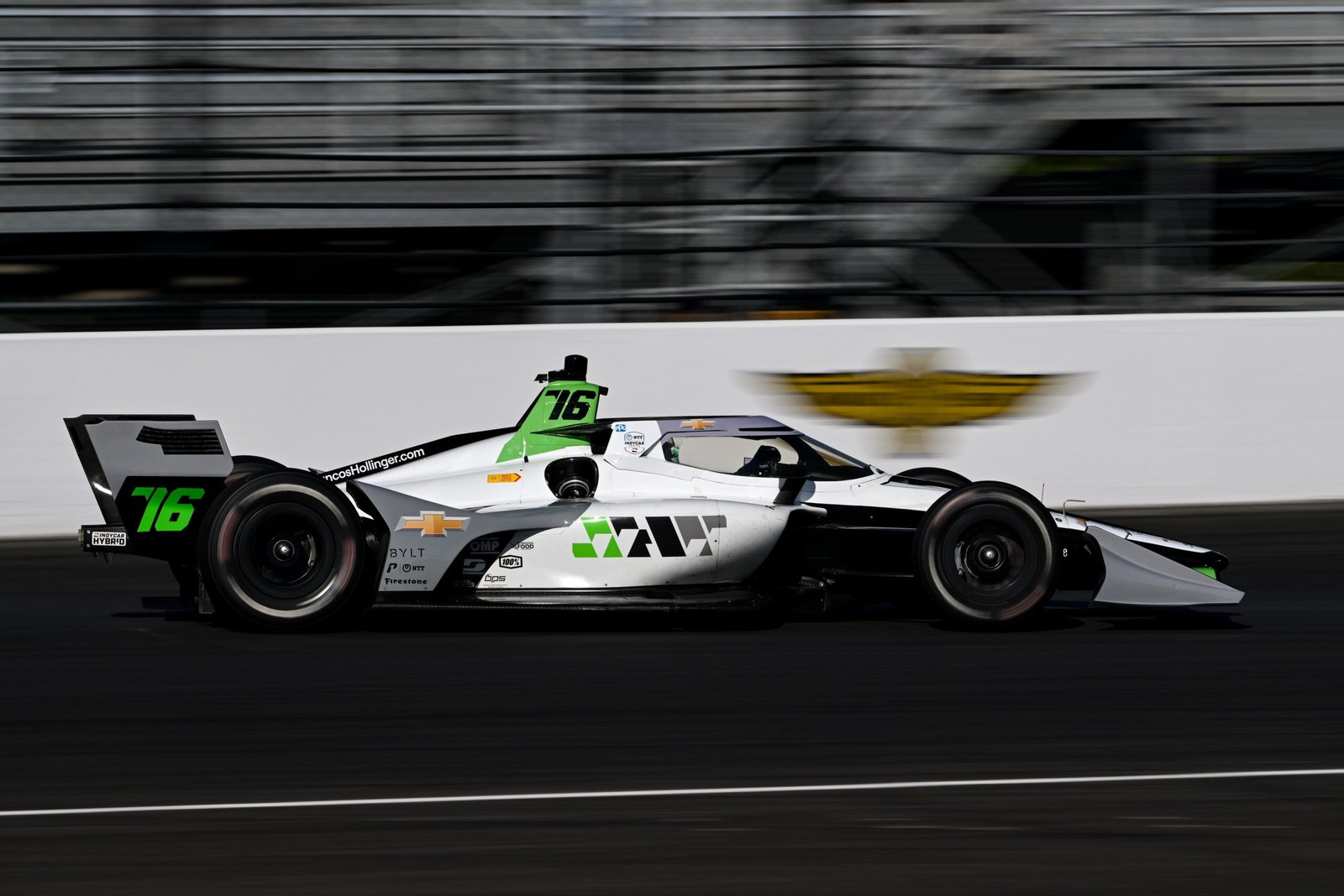
In early February, Schumacher completed his first on-track oval test in an IndyCar, marking a significant milestone in his adaptation process. After simulator preparation and theoretical work, the reality of sustained high-speed running brought new sensations and new respect for the discipline.
By his own assessment afterward, the experience was not intimidating, but engaging.
It was, as he put it, fun.
That reaction matters. Because for Mick Schumacher, IndyCar in 2026 is not about rushing the learning curve, it is about embracing it.
written by Philipp Kraus // Media Credit: Penske Entertainment